
Access Denied
IMPORTANT! If you’re a store owner, please make sure you have Customer accounts enabled in your Store Admin, as you have customer based locks set up with EasyLockdown app. Enable Customer Accounts

Antony Gormley
Antony Gormley, one of the UK’s leading sculptors, is known worldwide for works that explore the relationship between the human body and space. His sculptures are installed around the globe and can also be seen in Japan, including at Tokyo Opera City and in Osaka. For this project, he worked with the carvers and printers of the Adachi Institute of Woodcut Prints to create an entirely new kind of woodcut print.
RAPT was conceived in June 2024, when Gormley visited the Adachi Institute of Woodcut Prints in Tokyo. Drawing on his profound knowledge of Edo period (1603-1868) ukiyo-e and the context in which it was produced, he put the following proposal to the carvers and printers involved in the project
Antony Gormley proposed an approach in which he would brush ink onto each sheet to create the backgrounds. The carver would carve only the figure and the plateau on which it stands, and the printer would print that single block onto the prepared sheets.
Having the artist create the backgrounds by hand and then printing over them from a block was a method without precedent. However, Gormley’s insight and deep understanding of the medium brought this first attempt to fruition, opening up new possibilities for woodcut printmaking. The result is RAPT.

RAPT: Concept and Process
The new woodcut print RAPT, a collaboration between the internationally renowned sculptor Antony Gormley and the Adachi Institute of Woodcut Prints, was produced through an unprecedented process devised by the artist.
The production process had the following stages.
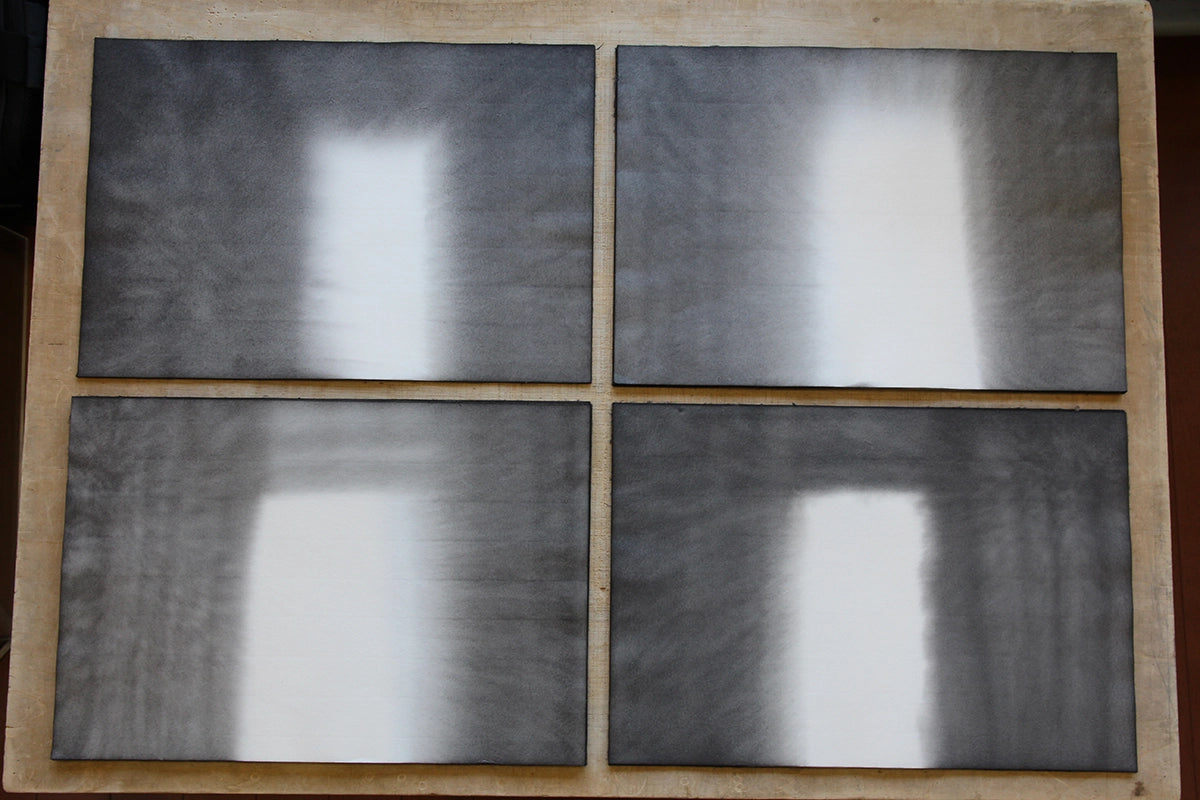
The artist himself brushed ink onto each sheet individually to create the backgrounds.
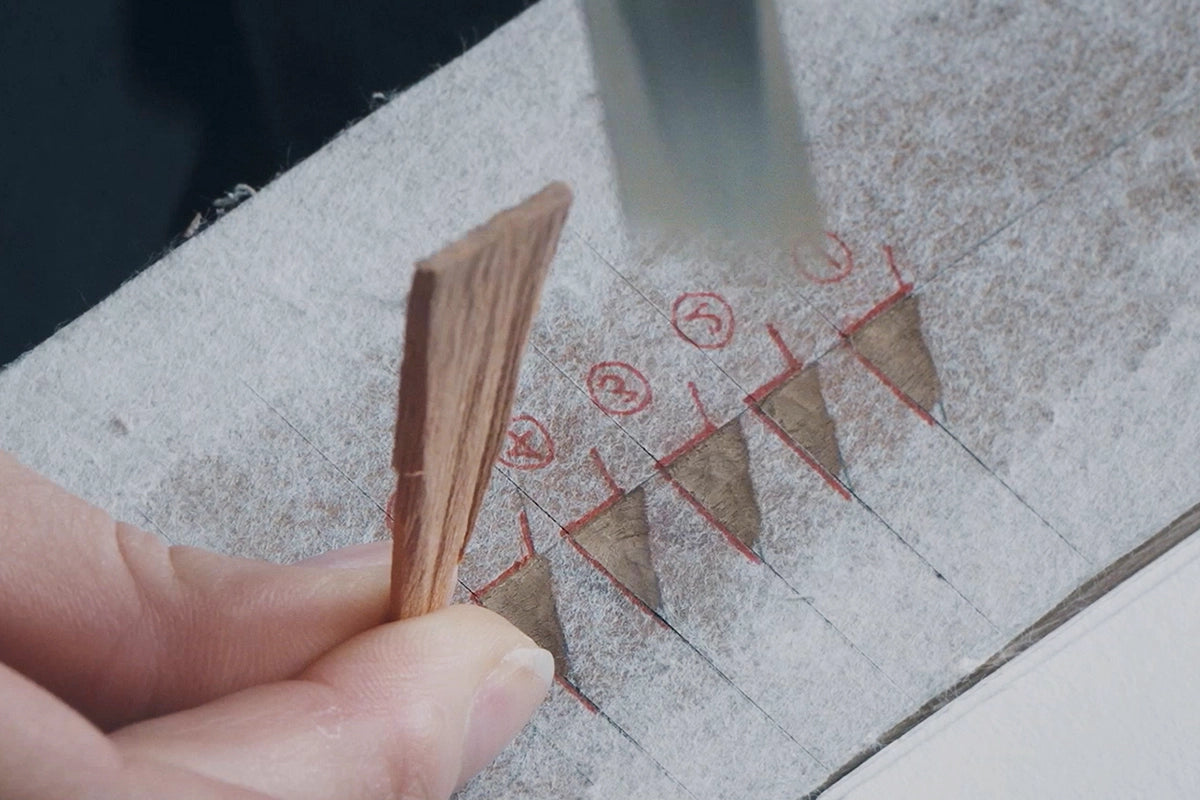
The carver then produced a single block containing only the figure and the plateau, adding multiple registration marks so that it could accommodate the different backgrounds.
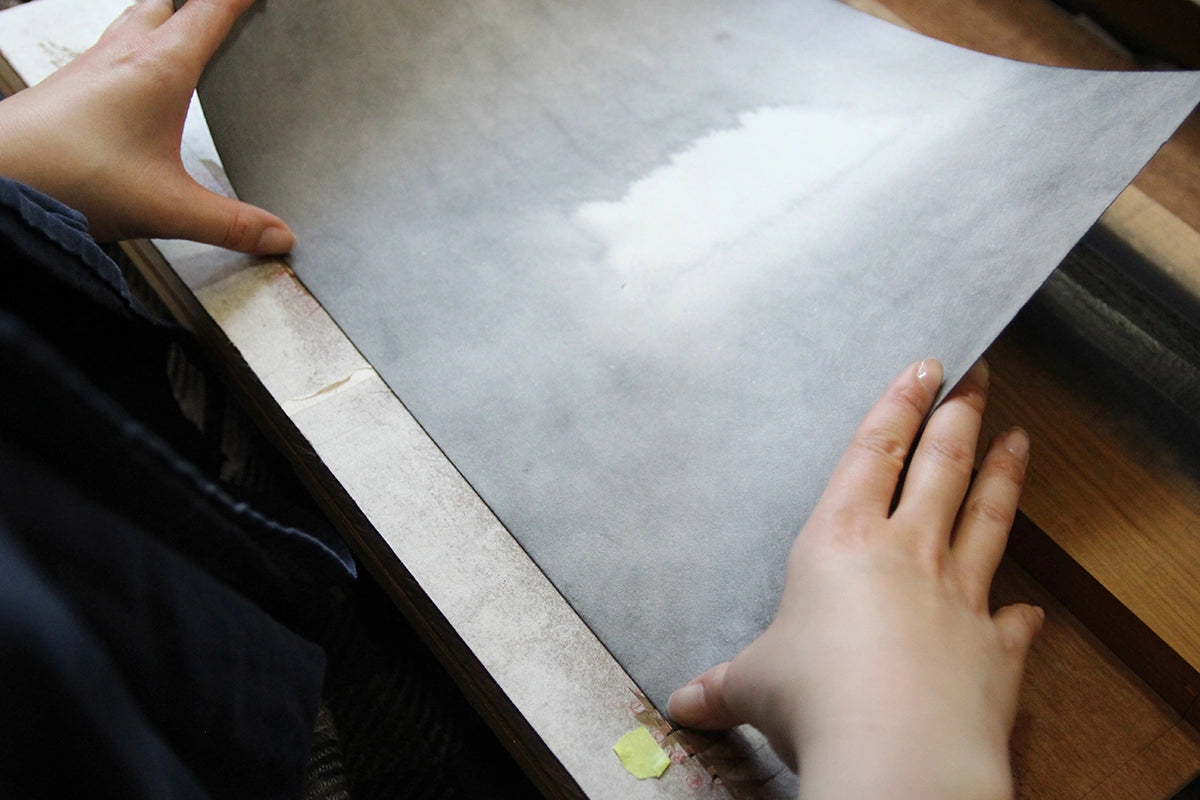
Finally, the printer carefully pulled each impression one by one, adjusting the registration to match each different background.
Before production began, Gormley worked with the carvers and printers to test whether the bleeding effects he envisioned could be achieved on the Echizen kisuki washi, made from kozo mulberry, that the Adachi Institute uses. Once he had confirmed that the paper could produce the effects he wanted, it was flown to the UK, where he brushed the backgrounds onto each sheet individually.
During this testing process, he said:
“The challenge for me and the excitement is to bridge this... in a way tradition, a way of being and working with contemporary conditions. and that's an adventure but it's a necessary adventure.”
Taking these words to heart, the carvers and printers joined Gormley in rising to this new challenge. The completed work demonstrates what becomes possible when an artist’s original vision meets the highly refined skill of today’s master carvers and printers, opening up new horizons in woodcut printmaking.
彫ーCarving process
Pouring every ounce of energy into carving a single block
The block bears a figure, a projection of Antony Gormley himself, and a plateau on which it stands. Using the small kogatana cutting knife that is regarded as the soul of his craft, the carver poured all of his energy into carving this single block. He also faced an unfamiliar challenge: printing the forward-leaning figure in exactly the right position against backgrounds that differ from one impression to the next. To solve this, he devised a method of cutting multiple registration marks into the block, allowing the printer to position the figure precisely in response to each individual background.

摺ーPrinting process
A master artisan attunes himself to the background and finds the right position for the figure
To accommodate backgrounds that differ from one impression to the next, the printer took on the formidable challenge of working with multiple registration marks to place the figure exactly where Gormley wanted it to be. He threw himself wholly into the task the artist had entrusted to him, and sheet by sheet, he attuned himself to each background and carefully brought the figure into position.


Artist Profile
<p>Antony Gormley</p>
Born in 1950 in London, UK. Widely acclaimed for his sculptures and public artworks that investigate the relationship of the human body to space. His work has been exhibited at Musée Rodin (2023), Lehmbruck Museum (2022), National Gallery Singapore (2021), Royal Academy of Arts, London (2019), Uffizi Gallery (2019), Philadelphia Museum of Art (2019), Long Museum (2017), Kunsthaus Bregenz (2010), Hayward Gallery (2007), and Malmö Konsthall (1993). Permanent public works include the Angel of the North, Another Place, and Inside Australia. Awarded the Turner Prize in 1994, the Obayashi Prize in 2012, and the Praemium Imperiale in 2013.
<Shipping Fee>
| 配送先/Destination | 額付/Framed Print |
| 日本国内 Inside of Japan |
無料/Free |
| アジア East Asia・Southeast Asia |
¥18,000 |
| アメリカ North America |
¥20,000 |
| ヨーロッパ・オセアニア Europe・Oceania |
¥21,000 |
| 南米・アフリカ・その他 South America, Africa, Other Areas |
¥27,000 |
| (2026年3月現在 / As of March 2026) |
Featured Products
Sold out

Save ¥900
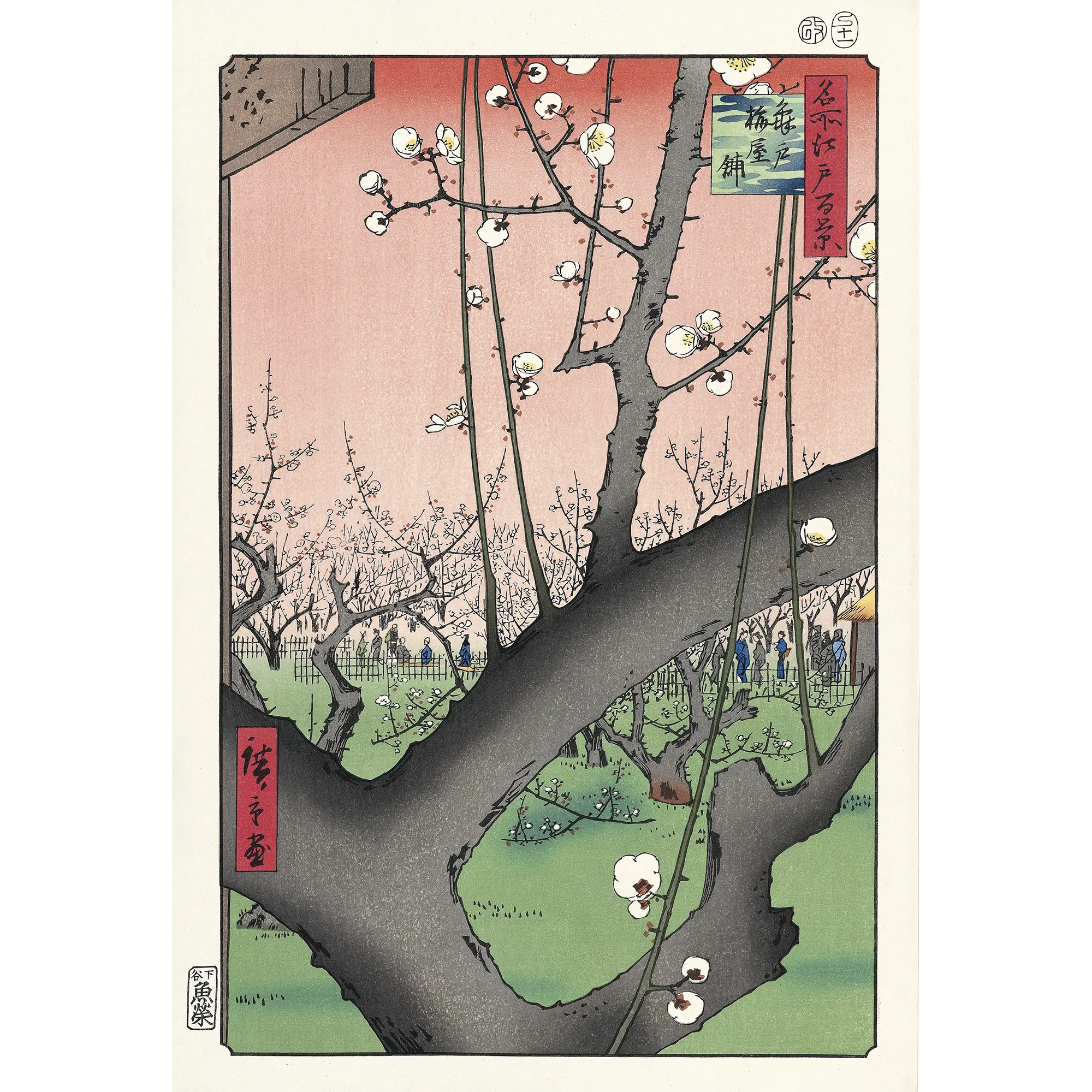
Utagawa Hiroshige(歌川広重)【This item is currently on back order】Plum Garden at Kameido -One Hundred Famous Views of Edo-
Sale price¥17,100
Regular price¥18,000
Invalid password
Enter