

Access Denied
IMPORTANT! If you’re a store owner, please make sure you have Customer accounts enabled in your Store Admin, as you have customer based locks set up with EasyLockdown app. Enable Customer Accounts

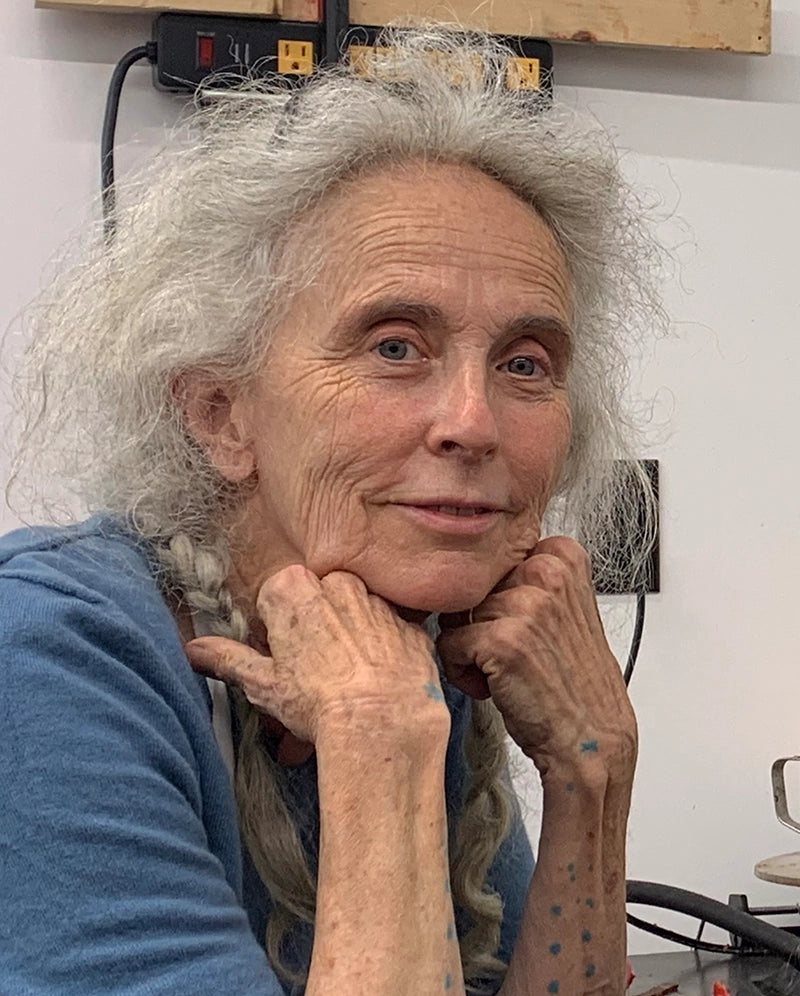
Kiki Smith
Kiki Smith, one of America’s leading artists, has been showing work in a wide range of media including sculpture, printmaking, glass, and textiles since the 1970s, with a consistent focus on the human body and the cycles of life. She drew global attention in 2022 when she was selected alongside Yayoi Kusama to create permanent mosaic murals for the new Grand Central Madison terminal in New York.
The woodcut print Paper Wasps Nest, produced through Smith’s collaboration with the Adachi Institute of Woodcut Prints, depicts a wasps’ nest on a pine branch. For this work, the team set out to reproduce the four-color system used in modern printing — known as CMYK for cyan (C), magenta (M), yellow (Y), and black (K) — using the traditional woodcut technique of layering water-based pigments on washi paper. The result demonstrates what becomes possible when an artist’s original vision meets the highly refined skill of today’s master carvers and printers, opening up new horizons in woodcut printmaking.
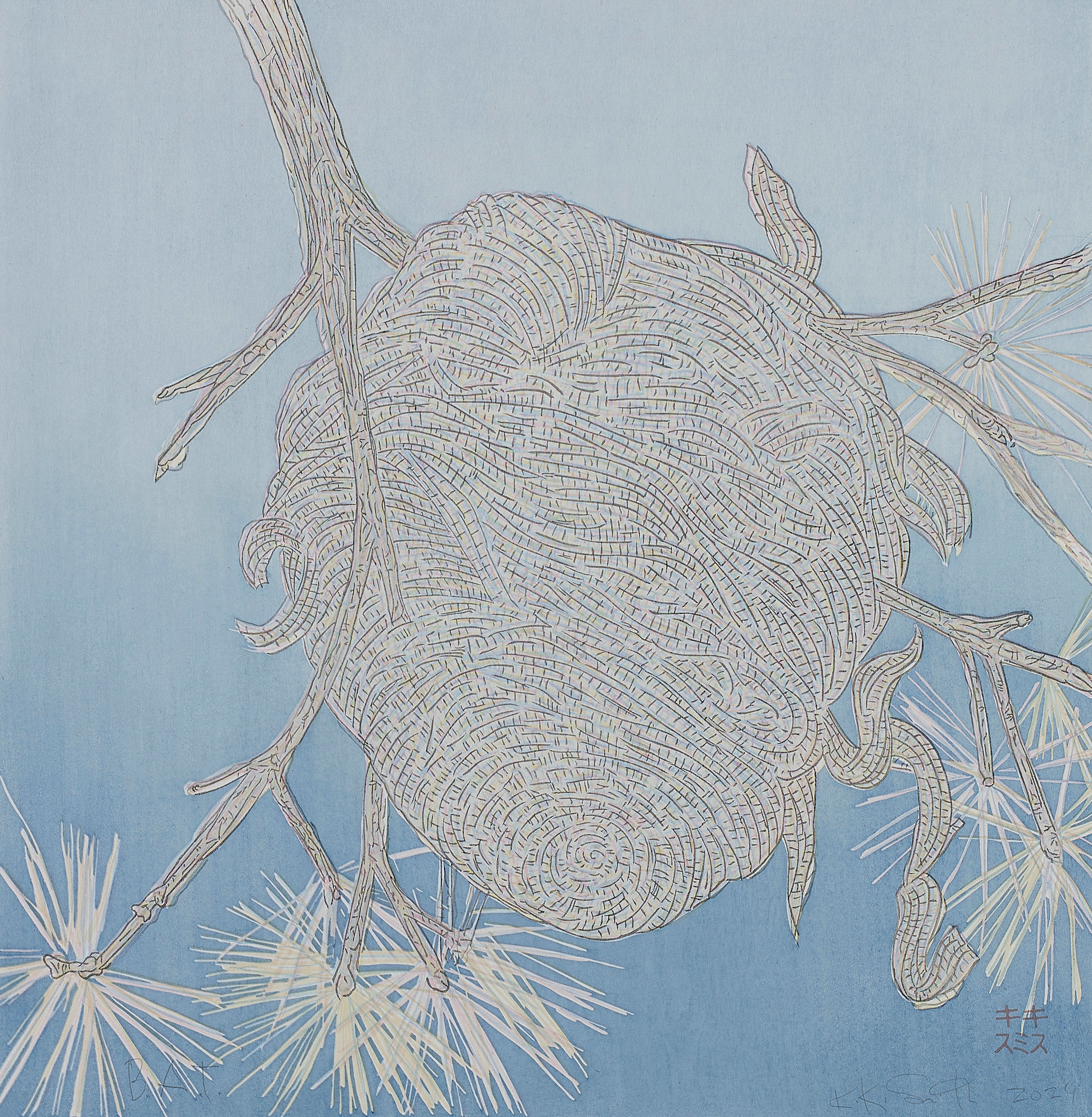
Paper Wasps Nest: Concept and Process
The new woodcut print Paper Wasps Nest, a collaboration between the internationally acclaimed artist Kiki Smith and the Adachi Institute of Woodcut Prints, grew out of a challenge posed by Smith herself: could the four-color system used in standard printing, employing cyan (C), magenta (M), yellow (Y), and black (K), be reproduced in a traditional woodcut print by layering water-based pigments on washi paper?
The production process had the following stages.
・Rather than a finished image, the artist provided separate line drawings for each of the four colors (C, M, Y, K).
・The carver pasted each drawing onto a woodblock and carved them one color at a time.
・The C, M, and Y blocks were printed sequentially in a process of subtractive color mixing, in which overlapping colors gradually shift toward a gray approaching black.
・The black (K) key block was then overprinted to define the contours and structure of the image.
・Finally, the clear blue sky visible through the hornets’ nest hanging in the pine tree was rendered using the bokashi gradation that is a hallmark of ukiyo-e.
The completed Paper Wasps Nest is a work that points to new possibilities for woodcut printmaking, emerging from the meeting of Kiki Smith’s original vision and the advanced skills of contemporary carvers and printers.

彫ーCarving process
The delicate lines of the wasps’ nest, brought forth by the carver’s blade
With complete command of the small kogatana cutting knife regarded as the very soul of his craft, the carver worked rhythmically to cut the hard mountain cherry blocks. During production, Kiki Smith joined online meetings, and the carver and printer talked through the finer details directly with the artist.

摺ーPrinting process
The luminous transparency Smith sought, brought to life through washi paper and water-based pigments
Pressing water-based pigments into Echizen kisuki washi paper made from kozo mulberry with a baren elicits the luminosity that is the hallmark of woodcut prints. In this work, those colors bring the wasps’ nest and the clear sky to life. During online meetings with Smith, the carver and printer talked through the finer details and tonal qualities with the artist.


Artist Profile
<p>Kiki Smith</p>
Born in 1954 in Nuremberg, Germany. Moved to the US the following year. Explores themes of death, rebirth, and sexuality through sculpture, printmaking , and video. Gained visibility through a project at the Museum of Modern Art, New York in 1990, and was highly lauded for her work at the 2005 Venice Biennale. The retrospective Kiki Smith: A Gathering, 1980–2005, organized by the Walker Art Center, traveled to the San Francisco Museum of Modern Art and the Whitney Museum of American Art. Received the Edward MacDowell Medal in 2009 and the U.S. Department of State Medal of Arts in 2012. Works are in collections including the Museum of Modern Art, New York and the Art Institute of Chicago.
<Shipping Fee>
| 配送先/Destination | 額付/Framed Print |
| 日本国内 Inside of Japan |
無料/Free |
| アジア East Asia・Southeast Asia |
¥13,000 |
| アメリカ North America |
¥15,000 |
| ヨーロッパ・オセアニア Europe・Oceania |
¥18,000 |
| 南米・アフリカ・その他 South America, Africa, Other Areas |
¥28,000 |
| (2026年3月現在 / As of March 2026) |
Featured Products

Invalid password
Enter